
TL;DR: Ball transfer units earn their keep at workstations, sort points, and merges. Roller conveyors win for linear, high-throughput transport of medium-to-large packages. The deciding factor is required flow geometry combined with the product’s bottom footprint. Most modern facilities use both, embedding ball transfer islands within long roller runs.
The Real Decision Isn’t Ball vs. Roller — It’s Flow Geometry
Most facility engineers come at this comparison looking at product weight or cost per foot. That framing leads to expensive retrofits about eighteen months in.
The actual deciding factor is flow geometry. Roller conveyors are linear devices, full stop. A 1.9-inch gravity roller moves product from Point A to Point B along a fixed path. If an operator needs to turn a box 90 degrees to scan a barcode or slap a label on, they have to physically lift it against gravity, fighting friction and risking a shoulder.
Ball transfer units are omnidirectional. A load can move, spin, or reverse direction on a horizontal plane with almost no operator effort. If your flow pattern requires branching (multiple discharge lanes off one table), rotational positioning (kitting, packing), or any manual multi-directional sort, a straight roller run will bottleneck the whole process. Match the equipment to the flow pattern first. Load capacities come after.
Where Ball Transfer Units Win (and Where They Quietly Fail)
Ball transfer units are omnidirectional load supports used wherever product has to move or rotate in more than one direction. They dominate at manual pack-out stations, sheet metal punch press feeds, and manual merge junctions where two conveyor lines come together without powered diverters.
A standard unit is a large load-bearing ball (typically 1″, 1.5″, or 2″) sitting on a bed of smaller support bearings inside a hemispherical cup. Heavy-duty variants, like the Omnitrack 9000 series, can support up to 10,000 lbs (4,590 kg) per unit. That’s a lot of ball.
They also have hard failure modes, and the failure is quiet right up until it isn’t. Corrugated cardboard dust is the usual killer. It works its way into the open ball cup, mixes with whatever factory oil is floating around, and seizes the support bearings underneath the main ball. By the time an operator notices a ball is dragging, three more are already stiff. They also hate soft-bottomed loads: polybags, uneven castings, anything that snags on the gap between balls.
| Scenario | Verdict |
|---|---|
| Operator needs to spin a 50 lb box to tape it | Works perfectly |
| Transporting sealed boxes 50 feet across a warehouse | Avoid (too expensive, high friction over distance) |
| Moving polybags or soft totes | Avoid (snag hazard) |
| Manual sorting from 1 line into 3 packing lanes | Works perfectly |
Where Roller Conveyors Dominate — and Their Hidden Weak Points
Roller conveyors are the default for linear transport, long accumulation runs, and heavy pallet handling. They give you a continuous support line across the width of the conveyor, the BF dimension.
Standard gravity rollers come in diameters dictated by load: 1-3/8″ for light packages, 1.9″ as the industry standard for medium-duty boxes, and 2.5″ or 3.5″ for heavy industrial loads and pallets. Because the bearings are sealed at the ends of the tube, they shrug off cardboard dust and general surface debris.
The weak point is inflexibility. Changing direction means a powered diverter, a pop-up transfer module, or a curved roller section with a fixed radius. And small items will fall through the gaps if the pitch is wrong.
The Minimum Product Footprint Rule (Most Guides Skip This)
A package has to be supported by at least three balls or three rollers at all times. This is a CEMA rule and it is non-negotiable.
If a box is supported by only two rollers, it dips into the gap, the leading edge strikes the next roller, and you have a jam. To calculate the maximum allowable roller pitch, divide your shortest product length by three.
- Formula: Max Pitch = Shortest Product Length ÷ 3
- Example: Smallest box is 9 inches long, max roller pitch is 3 inches.
The same math applies to ball transfer tables. A 9-inch box needs ball grid spacing of no more than 3 inches. If you spec a standard 4-inch or 6-inch grid to save money, that 9-inch box will tip and dive, and you’ll be back on the phone with the integrator inside a quarter.
| Shortest Product Length | Max Roller Pitch | Max Ball Grid Spacing |
|---|---|---|
| 6 inches | 2 inches | 2 inches |
| 9 inches | 3 inches | 3 inches |
| 13.5 inches | 4.5 inches | 4.5 inches |
| 18 inches | 6 inches | 6 inches |
Load Math — Point Loads, Line Loads, and Package Damage
Ball units concentrate weight at discrete contact points. Rollers distribute it along a line. That physical difference dictates what kind of packaging you can run on each.
A 60 lb box on a roller conveyor spreads across roughly a 15-inch line of steel. The same 60 lb box on a ball transfer table with 4-inch grid spacing rests on three or four 1-inch steel balls. That’s a severe point load. Standard 32 ECT corrugated has decent vertical stacking strength but low puncture resistance on its flat faces, so those point loads indent the bottom, lock the box into the ball cups, and now the operator is shoving the box with both hands to break it free. Anecdotally, that’s where most of the “the new table is slower than the old one” complaints come from in the first month after a retrofit. Soft-wall plastic totes and blister packs do the same thing. If the product bottom is soft or thin-walled, use rollers, or spec a dense ball grid (1-inch spacing) and accept that the table cost just doubled.
Lifetime Cost Reality — Beyond the Purchase Price
Comparing upfront per-foot cost of a gravity roller to a ball transfer table misses total cost of ownership over any realistic horizon.
Standard ABEC-1 bearings in a 1.9″ roller will last a decade in a dry warehouse with zero maintenance. Zero. Ball transfer units need active maintenance because the main ball sits in an open cup collecting debris. Manufacturers like Alwayse offer units with dirt exit holes at the bottom so dust falls through, which helps. In wet or food-grade environments you’re specifying stainless, IP-rated for washdown, and the cost per ball jumps from roughly $5 to $25 or more.
Run the math on 50 packing stations, each with a 24″ x 36″ table on a 3-inch grid. That’s 96 balls per table. Replacing seized carbon-steel balls every 18 months because nobody budgeted for the dust will eat the initial purchase price in a hurry.
The Hybrid Reality — Why Most Real Installations Use Both
Pure either/or framing is misleading. Most fulfillment centers and manufacturing lines run hybrid layouts.
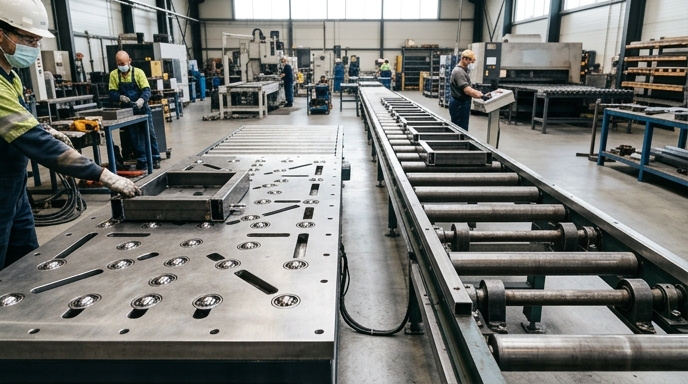
Gravity or powered rollers do the main transport runs and feed into ball transfer “islands” at specific workstations. Typical layout: a long roller line brings boxes to a pack station, the operator pulls the box onto a recessed ball transfer table, spins it 360 degrees to scan-tape-label, then pushes it onto a takeaway roller line.
Transition design is where this lives or dies. Integrators typically recess the ball transfer table about 1/16″ to 1/8″ below the feed line of the roller conveyor. If the ball table is perfectly flush, or (worse) slightly high, the leading edge of a heavy box slams into the steel housing of the first row of balls. Jam, dent, operator yelling at maintenance. I’ve seen a brand-new install get torn out and reset in week one over an eighth of an inch.
A Decision Framework You Can Actually Use
Answer these five in order:
- What is the flow pattern? Linear, use rollers. Rotational or multi-directional, use ball transfers.
- Shortest product dimension? Divide by three. That’s your pitch or your grid.
- Bottom material? Soft, flexible, or thin corrugated, go rollers.
- Environment? Heavy cardboard dust, metal shavings, sticky residue — avoid standard ball transfers unless you’re specifying self-cleaning or washdown units.
- Operator interaction? OSHA ergonomic guidance puts workstation height at 30-38 inches and keeps push/pull forces low. If an operator has to manually turn a box over about 20 lbs, give them a ball transfer island.
Example: E-commerce pack station, 5-15 lb boxes, smallest box 6 inches long, dusty environment. Hybrid setup. Roller feed line. Small ball transfer island at the taping station with 2-inch grid spacing to support the 6-inch box. Specify ball units with dirt exit holes.
FAQ
Can ball transfer units handle heavy pallets?
Yes. Standard units are built for parcels, but heavy-duty machined units like the Omnitrack 9000 series handle up to 10,000 lbs per ball. You’ll see them in air cargo handling and heavy die-tool loading.
What’s the smallest package size for ball transfer tables?
Depends on ball spacing. Three-support rule applies: a table with 1-inch grid can handle a package as small as 3 inches long. Standard 3-inch spacing needs a minimum 9-inch package.
Are ball transfer tables louder than roller conveyors?
Yes, and it’s the kind of noise that gets complaints from the office area if the pack line is anywhere nearby. Ball units are metal-on-metal between the main ball and the internal support bearings, which gives you that distinct rattle. Modern roller conveyors with precision ABEC bearings and urethane sleeves are much quieter — in some cases almost silent at low speeds. If you’re putting a hybrid line near a mezzanine with desks on it, specify the quieter roller option and budget for sound-dampening at the ball island, or you’ll be dealing with HR before you’re dealing with maintenance.
Can you motorize a ball transfer table?
Rarely, and when someone tries, the mechanics get ugly fast. For automated multi-directional routing most people now use Flat Right Angle Transfer (F-RAT) modules from Itoh Denki and similar, which pop up belts and rollers instead of trying to drive the balls themselves.
Which is better for a pack-out station?
Hybrid. Ball transfer table in front of the operator, rollers in and out.
Leave A Comment