
TL;DR
Ball transfer units are omnidirectional load bearings used in transfer tables, work positioning stations, assembly fixtures, and machine infeed/outfeed. They need rigid, flat-bottomed loads to work properly. They are the wrong choice for soft loads, undersized loads, or dirty environments without the right sealing strategy.
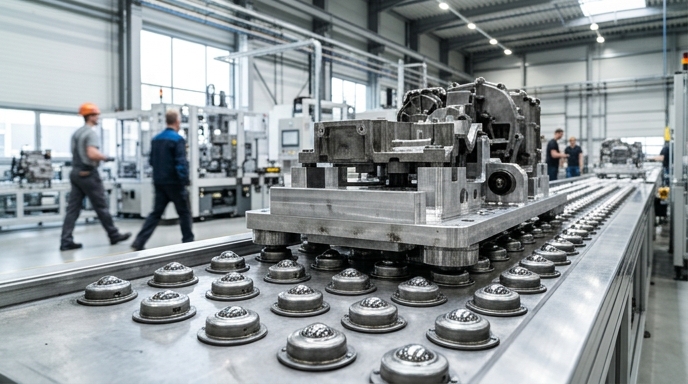
The Problem BTUs Solve That Rollers Can’t
Ball transfer units (BTUs) give you omnidirectional movement for rigid loads. Gravity rollers and skate wheels only move things along one axis. A BTU lets an operator rotate, divert, or hand-align a load mid-stream without a powered turntable or a lift assist.
A standard BTU runs at a coefficient of friction around 0.03. In practice that means a 1,000 kg load takes roughly 30 kg of lateral push to get moving, give or take whatever your floor and your operator’s shoes are doing that day.
When somebody’s deciding between omnidirectional options, the comparison usually comes down to BTUs, single-axis rollers, and powered omniwheels.
| Feature | Ball Transfer Unit | Gravity Roller | Skate Wheel | Omniwheel |
|---|---|---|---|---|
| Motion | 360° Omnidirectional | 1-Axis Linear | 1-Axis Linear | Multi-axis (often powered) |
| Load Rigidity Required | High (Flat, hard bottom) | Medium | Medium | Low (Handles softer loads) |
| Load Capacity | Up to 4,550 kg per unit | Up to 1,500 kg per roller | <50 kg per wheel | <100 kg per wheel |
| Primary Use | Manual rotation, diverts | Long-distance transport | Lightweight transport | Automated sorting |
Transfer Tables and Diverters in Packaging and Logistics
Transfer tables are the single largest use of ball transfer units. They sit at conveyor intersections and let operators push boxes through 90-degree turns, sort parcels into chutes, or induct items onto main lines by hand.
The number that matters here is ball pitch. The rule you’ll see in every reputable manufacturer’s technical sheet is the “3-ball rule”: the narrowest dimension of your load has to sit on at least three balls at all times, or it’ll dip between them and jam against a housing lip.
So if your facility runs boxes down to 150 mm wide, your maximum ball pitch is 50 mm. Simple division, and yet I’ve walked into facilities where somebody specced 75 mm pitch and then wondered why the small SKUs kept hanging up. High-speed parcel operations have mostly moved to shoe sorters or cross-belt sorters, but manual BTU tables are still the standard for exception handling and lower-volume manual sortation. Zero power draw, almost no maintenance, and nothing to fail during peak season.
Assembly, Weighing, and Inspection Stations
Work positioning stations put BTUs under a fixture so an operator can spin a heavy workpiece without a crane. Engine blocks, control panels, sub-assemblies: all the stuff you need to rotate three or four times to get at the fasteners on the back side.
Because push force drops to roughly 1-3% of the load weight, one operator can hand-index a 500 kg aerospace component with about 15 kg of effort. That’s the difference between a one-person station and a two-person station, which is the entire ROI calculation right there.
A lot of tier-one automotive suppliers spec spring-loaded BTUs for these stations. The unit depresses slightly under load, letting the workpiece settle onto a friction pad for the actual work. Release the clamping force and the springs push it back up onto the balls for the next rotation. It’s a nice solution when you need the part to stay put during torque application but spin freely between steps.
Machine Tool Infeed, Outfeed, and Die Handling
This is the section I care about most, because it’s where the wrong spec kills people, or at least kills budgets.
Press shops and CNC lines use BTUs on load decks so operators can position stock plates and heavy stamping dies without rigging a lift every time. Pushing a 2,000 kg steel die into a press bed needs serious load support under it, and the margin for error on a die change is low. You pick machined steel, high-capacity units, full stop. Omnitrack’s 9000 series handles up to 4,550 kg (10,000 lbs) per unit. Alwayse’s Hevi-Load range tops out around 4,000 kg per unit. Either will do the job; pick based on who your distributor actually stocks, because lead times on these are not fun.
Heat is where people get burned, pun intended. Standard BTUs use nylon or felt seals to keep debris out of the main cup. Nylon seals melt around 80°C. If you’re running hot-stamping dies or anything coming off a heat treat, you need to spec seal-less, all-steel units with high-temp lube, which will hold up past 150°C. I’ve seen a die handling station where somebody saved maybe four hundred bucks going with standard-seal units and then had to rip the entire deck out six months later because every ball was seized with carbonized nylon and scale. The replacement cost, counting downtime, was something like twenty times the original spec difference.
One more thing on dies: weep holes matter even in a clean press shop, because the mill scale coming off hot steel will find its way into everything.
Aerospace Cargo Loading — The Benchmark Application
Aircraft cargo decks are the most demanding BTU application in the world. The units have to take shock loads, temperature swings, de-icing fluid, and whatever the ground handler drops on them, all under FAA and military specs. Commercial freighters like the 747 and 777 and most military transports use ball mats built right into the floor to position ULDs and pallets.
This is a cataloged-parts world. You don’t repurpose industrial BTUs here. SKF and Alwayse both produce dedicated cargo ranges, built to be light, corrosion-resistant, and able to shed water and glycol without seizing.
A standard aerospace cargo BTU has to support dynamic loads around 400 to 500 lbs per unit while surviving flight vibration and the occasional ULD getting dropped onto the deck from a loader. They almost always have dirt-exit holes at the base so sand and fluid pass straight through the housing instead of pooling inside.
Specialty Uses — Where BTUs Show Up That Nobody Expects
Outside warehouses and machine shops, BTUs quietly solve friction problems in some odd places:
- Medical and hospital equipment. Patient transfer tables and MRI bed slides. Type 316 stainless housings and balls, because they get hit with the full chemical washdown cycle.
- Mortuary tables. Same corrosion story, different context. Stainless BTUs let the trays slide in and out of refrigeration without binding.
- Stage sets. Multi-ton rotating scenery pieces often ride on inverted BTUs so stagehands can turn them silently mid-performance. (The silent part is why you don’t see powered turntables in older theaters.)
- Robot end-effectors. Miniature BTUs on custom grippers, letting a workpiece self-align before the gripper fully clamps. Not glamorous but it eliminates a whole class of pick-and-place errors.
Where Ball Transfer Units Are the Wrong Choice
BTUs are the wrong call when the load is soft, smaller than your calculated minimum footprint, or sitting in an uncovered dirty environment without the right sealing.
The most common failure mode is somebody ignoring the 3-ball rule. If a package is 100 mm wide and you’ve got your BTUs on 50 mm pitch, it only touches two balls. It dips, catches the housing, jams. Every time.
Soft loads fail immediately on ball tables. Shrink-wrapped multipacks, polybags, uneven wood pallets: they deform around the sphere and mechanically lock in place. You end up with torn packaging and a pissed-off operator pushing twice as hard as the friction calc said. Soft loads want skate wheels or flat belt, not BTUs.
Contamination is the other disqualifier. Standard pressed-steel BTUs will seize in dusty environments. Woodworking shops, foundry floors, anywhere with fine abrasive airborne. The felt seal that’s supposed to protect the cup instead traps the dust against the internal support balls, those bind, and now your main ball isn’t rolling anymore. It’s just dragging across the bottom of the load, gouging it. In debris-heavy environments you either spec weep-hole units with no seals, or you give up on BTUs and move to air casters.
Selecting the Right BTU for Your Application
Picking a BTU comes down to load per unit, orientation, ball material, and housing style.
Orientation is the one that catches people out. Standard pressed-steel BTUs lose 50% of their rated capacity when mounted inverted (ball down, acting as a caster). A unit rated for 100 kg face-up is a 50 kg unit face-down. Heavy-duty machined units like the Omnitrack 9000 series use a different internal recirculation and don’t derate when inverted at all, which is why they end up specced into overhead and side-mount applications even when the load numbers don’t obviously demand them.
| Environment | Load per BTU | Orientation | Recommended BTU Spec |
|---|---|---|---|
| Clean / Dry | < 50 kg | Upright (Ball Up) | Pressed Steel, Carbon Steel Ball |
| Dusty / Debris | < 100 kg | Upright (Ball Up) | Base weep hole, No seal |
| Heavy / Shock | > 1,000 kg | Any Angle | Machined Steel (e.g., Omnitrack 9000) |
| Washdown / Medical | < 200 kg | Upright (Ball Up) | All Stainless Steel (Type 316) |
| High Heat (>80°C) | < 500 kg | Upright (Ball Up) | Steel housing, No nylon seal, High-temp lube |
I still spec all-stainless for mortuary applications even when the client swears they’ll never use the harsher disinfectants. Old habit from a bad callback years ago, not strictly justified by the chemistry.
FAQ
How many ball transfer units do I need under a given load?
Take the load weight, divide by the number of units actually in contact. The catch: because of surface irregularities you should assume only 3 BTUs are carrying the full weight at any one moment, not however many are theoretically under the footprint. Then for spacing, run the 3-ball rule: narrowest load dimension divided by 3 gives you your maximum pitch between ball centers. If the math gives you a pitch tighter than the housing diameter of the unit you want, you need a smaller BTU, not a creative interpretation of the rule.
Can ball transfer units handle wet, washdown, or food-contact environments?
Yes, if they’re built entirely from Type 316 stainless. Carbon steel will rust and nylon seals will degrade under chemical washdown. Wet-environment units need weep holes so fluid drains out of the cup instead of pooling in it.
What’s the maximum load capacity of a single ball transfer unit?
Standard pressed-steel units cap out around 100 to 200 kg. Machined heavy-duty units like the Omnitrack 9000 or Alwayse Hevi-Load go up to 4,550 kg (10,000 lbs) per unit.
Can BTUs be mounted upside down or sideways?
Yes. Standard pressed-steel units lose half their capacity inverted. If you need full capacity at any angle, spec a machined heavy-duty unit built for it.
Leave A Comment