
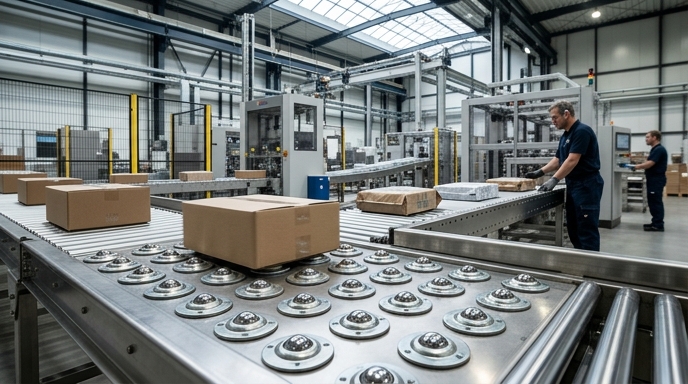
Ball transfer units move packages omnidirectionally in packaging lines, enabling manual rotation, diverting, and merging without powered actuation. They show up heavily in case handling, pallet transfer, and pharma tote work, with load capacities running from 15 lbs up past 4,500 lbs per unit. For packaging engineers, the spec that matters most is the seal and drain rating. That’s what decides whether a unit lives six months or six years in washdown or dusty-case environments.
Where BTUs Beat Powered Alternatives on a Packaging Line
Ball transfer units (BTUs) outperform powered belts and rollers in four specific packaging line scenarios: operator-assisted orientation stations, low-speed merge/divert points, passive buffer zones between asynchronous machines, and manual inspection/reject stations. In these zones, you need omnidirectional movement, but the throughput doesn’t justify the cost or complexity of a motorized diverter.
A standard Motorized Drive Roller like the Itoh Denki PM486FS runs somewhere in the $150–$250 range per roller, and that’s before you add control cards and wiring. Industrial BTUs land between $15 and $50 per unit. A 3×3 grid of BTUs gives full 360-degree rotation for a fraction of the hardware cost of a pop-up powered diverter.
BTUs also simplify safety compliance. Powered rollers create pinch points that require guarding under ANSI/PMMI B155.1. A passive BTU table has none, so operators can work directly alongside the conveyor surface during manual case packing or QC.
Load Distribution Math for Package Grids
Calculating required load capacity for a BTU means dividing total package weight by three. That’s the standard engineering convention published by Alwayse, Omnitrack, and most of the catalog guys.
The reason: shipping cases, plastic totes, and wooden pallets are rarely perfectly flat, so only three balls are guaranteed to bear the load at any given moment. A 40 lb corrugated case gives you 40 / 3 = 13.3 lbs. Spec a BTU with a dynamic load rating of at least 13.3 lbs per unit. Add your safety factor on top of that, not inside it — I’ve seen engineers double-dip the safety factor and then wonder why their line costs twice what it should.
For flexible loads like heavy polybags or bulk powder sacks, the load distributes more evenly across the grid, and you can divide total weight by the number of balls actually in contact with the package footprint. But for rigid corrugated cases and plastic totes, stick with divide-by-three. It prevents the localized overloading that deforms the main ball and chews up the support bearings underneath.
One more thing on this: the divide-by-three rule assumes the package is roughly centered. If your line pushes cases against a side rail, two of those three contact points shift to one side of the grid and the load distribution gets ugly fast.
Hygienic & Washdown Specs for Food, Beverage, and Pharma
Food-contact packaging lines require sealed stainless BTUs rated for washdown, but true hygienic certification is a gray area, and this is where I spend half my consulting time arguing with vendors.
True EHEDG Type EL Class I certification is exceptionally rare for ball transfer units. The mechanical reality of a BTU requires a clearance gap between the main load ball and the outer cup. That gap is an unavoidable harbor point for bacteria and biofilm, which makes strict 3-A or EHEDG certification nearly impossible for standard designs. Anyone selling you a “fully EHEDG certified” BTU for a raw dairy line is either exaggerating or quoting a certification that applies to one specific sub-component, not the assembly.
To actually survive in dairy, meat, and pharma packaging, manufacturers rely on hygienic design modifications rather than certifications. Units like the Omnitrack 9000 series use 316L stainless housings with large base drain holes. During Clean-in-Place (CIP) washdown, high-pressure water flushes through the cup and exits the bottom, so fluid doesn’t pool and sit there growing things between shifts.
For direct food contact, spec nylon or Delrin load balls. They comply with FDA 21 CFR 177 for food-contact plastics and don’t generate the metal-on-metal wear particulate you get from carbon steel on steel. The tradeoff is load capacity and thermal limit, which gets covered later.
Failure Modes Unique to Packaging Environments
Packaging lines introduce specific contaminants that destroy standard carbon steel BTUs. Generic wear is rarely the cause. It’s almost always environmental debris getting into the cup and killing the support balls underneath.
| Contaminant | Primary Failure Mode | Mitigation |
|---|---|---|
| Corrugated dust | Packs into felt seals, seizes the main ball | Scraper seals or open-bottom designs |
| Shrink wrap / stretch film | Shards wrap the ball shaft, friction lock | Knife-edge scraper seals |
| Sugar syrups / hot melt | Adheres to ball, drags residue into cup | Base drain holes for hot water flushing |
| Flour and powders | Cakes inside cup, displaces support bearings | Open-bottom “dirt exit” designs |
Standard felt-sealed BTUs fail within weeks on high-volume corrugated case lines. This isn’t a vendor-smearing claim, it’s the single most reported BTU failure mode in packaging. Cardboard dust bypasses the felt, mixes with ambient humidity, and forms a cement-like paste inside the cup. The mitigation is to spec open-bottom units. The bottom of the hemispherical cup is removed, and dust and dry debris fall through the unit instead of accumulating inside.
Felt seals exist because somebody decided dust was the enemy. On a packaging line, the seal itself is the enemy.
Spacing, Layout & Package Footprint Rules
To calculate grid spacing, divide the narrowest dimension of the smallest package by three. That gives you a minimum of three balls under the package at all times and keeps the leading edge from dipping between units and jamming.
If your smallest case is 9 inches wide and 12 inches long, maximum allowable pitch (center-to-center between balls) is 3 inches.
Spacing rules change based on package material. Rigid plastic totes with reinforced ribbed bottoms need tighter spacing so the ribs don’t fall into the gaps. Flat-bottomed wooden pallets allow wider spacing, often 6 to 8 inches on heavy-duty units. For lightweight polybags in e-commerce fulfillment, skip BTUs entirely. The flexible plastic sags between the balls no matter what pitch you pick.
BTUs in Robotic & Automated Packaging Cells
Ball transfer units frequently serve as passive accumulation surfaces downstream of robotic case packers. When a cobot from FANUC or Universal Robots loads a case, the finished box gets pushed onto a BTU grid, which creates a zero-pressure buffer zone before the palletizer.
BTU grids play well with vision systems too. Highly polished powered rollers create glare and reflections that confuse overhead cameras during part location or barcode scanning. Matte-finish stainless BTUs give you a stable, low-glare background. And because the table is unpowered, cases sit completely stationary during the camera’s exposure, which eliminates motion blur without any PLC-controlled stop sequence.
Selection Checklist — Specs That Actually Matter
When you’re specifying BTUs, prioritize load rating, material, and temperature limits over whatever marketing claims are on the catalog cover.
- Load rating (with safety factor): Apply divide-by-three. A 75 lb capacity unit, like the Hudson Bearings SBT-1 with a 1-inch ball, safely supports a 225 lb rigid case.
- Ball material: Carbon steel for highest load. Stainless (304 or 316) for washdown corrosion resistance. Nylon or Delrin to prevent marking on printed cartons and to meet food-contact rules.
- Temperature range: Nylon deforms above 80°C (176°F). For near-oven applications, carbon steel balls run safely up to 150°C (300°F).
- Mounting style: Flange mount drops into pre-punched sheet metal, fast to swap. Stud mount needs a nut threaded from below, which adds real labor time at replacement.
I still spec stud mount on new builds half the time, even though flange is objectively faster to service. Old habit from before quick-change flange plates were common, and I haven’t fully retrained myself.
Lifecycle Cost — When BTUs Are the Wrong Choice
BTUs aren’t always the cheapest long-term pick. On high-speed lines running over 100 CPM, they bottleneck. No positive drive means packages rely on momentum or gravity to clear the transfer zone, and at speed, cases collide, rotate out of square, and jam downstream guides.
In environments with heavy adhesives or hot melt, TCO on BTUs frequently exceeds powered alternatives. If a $20 BTU fouls with adhesive every three weeks, maintenance labor to unbolt and replace a 20-ball grid at roughly $45/hr eats the initial savings fast. In those specific high-fouling, high-speed scenarios, powered diverters like the Intralox DARB give you lower TCO despite the higher upfront capital.
Obviously you wouldn’t put a DARB on a 30 CPM manual pack-out station either. Pick the tool for the throughput.
FAQ
What load capacity do I need for a ball transfer unit under a standard shipping case?
Divide the heaviest case weight by three. Only three balls bear the load at a time. A 60 lb case needs BTUs rated at least 20 lbs each.
Can ball transfer units be used in food-contact packaging zones?
Yes, if specified correctly. Use 316L stainless housings with base drain holes for CIP washdown, paired with FDA 21 CFR 177 compliant nylon or Delrin load balls. True EHEDG certification is rare because of the ball-to-cup clearance gap, so don’t expect a vendor to hand you one; expect them to hand you a hygienic-design argument instead, and evaluate that on its own merits. For raw dairy or anything with a kill-step downstream, I’d push for the open-bottom drain design regardless of what the certification sheet says, because the drain geometry is what actually keeps the unit clean between CIP cycles.
How often do ball transfer units need to be replaced on a packaging line?
In clean, dry case handling, steel BTUs last 3 to 5 years. In dusty corrugated environments without open-bottom drains, felt seals pack with debris and fail in 3 to 6 months.
What’s the difference between ball transfer units and skate wheels for case handling?
Skate wheels move in one linear direction only. BTUs give true 360-degree omnidirectional movement, which is what you need for manual rotation stations, multi-lane diverters, and right-angle merges.
Do ball transfer units require lubrication or maintenance?
Most industrial BTUs ship pre-lubricated for life. Don’t add wet lube on a packaging line — it attracts cardboard dust and kills the unit faster than running it dry. Maintenance is dry wiping or hot water flushing for washdown-rated units.
Leave A Comment