
TL;DR: Ball transfer unit load capacity depends on three stacked factors: the single-ball rating, how many balls actually touch the load, and derating for shock, speed, and temperature. The rated capacity is almost never the usable capacity. Most engineers overestimate by 2 to 4 times. Here’s the real selection math.
Why Datasheet Capacity Lies to You (Politely)
A ball transfer unit’s rated load capacity assumes a centered, static, perpendicular load at room temperature. Those conditions rarely happen in production. Manufacturers test units on flat, hardened steel plates in controlled labs, which is fine for a datasheet and not fine for your shop floor.
When a datasheet lists a 250 kg maximum load, that means the unit can support 250 kg of dead weight without immediate mechanical failure. It does not mean the unit will roll smoothly under that weight, and it says nothing about side-loading. The Omnitrack 9250 high-capacity unit is rated for 4590 kg, but that rating requires the load to sit at exactly 90 degrees to the ball surface. Hit it at 45 degrees and the internal recirculating balls bind against the housing race. Effective capacity drops hard.
What “Rated Load” assumes:
- Load applied at exactly 90° to the ball
- Operating temperature between 15°C and 30°C
- Zero shock or impact on loading
- A hardened, perfectly flat mating surface
- Clean environment, no particulate ingress
Read the footnotes, basically. They’re where the real engineering lives.
Static vs. Dynamic vs. Impact — The Three Numbers That Matter
Ball transfer units carry three distinct load ratings: static (resting load), dynamic (moving load, usually 30 to 50% of static), and impact (momentary shock). A lot of low-cost suppliers only publish the static rating, which is how you get rapid field failures the first time anything actually moves.
Static capacity defines the weight the unit holds without permanently deforming the main ball or the internal support balls. Dynamic capacity defines what the unit can move while keeping an acceptable rolling resistance, usually a coefficient of friction somewhere around 0.01 to 0.03. Impact capacity is the peak force the unit absorbs from a dropped object. Drop a 50 kg steel block 100 mm onto a ball transfer unit and the momentary impact force easily exceeds 200 kg.
| Rating Type | Definition | Typical % of Max Stated Load |
|---|---|---|
| Static | Resting deadweight | 100% |
| Dynamic | Load in continuous motion | 30% – 50% |
| Impact | Momentary shock (drop/collision) | Requires 2.0x – 3.0x safety factor |
The Multi-Ball Contact Problem (and Why Dividing by Count Fails)
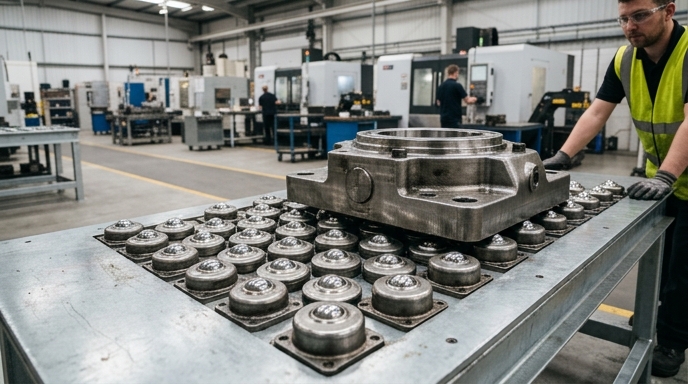
When a flat rigid object sits on an array of ball transfer units, typically only three balls carry the entire load at any moment. Not all the units in the array. Just three. This is the single most common sizing error in conveyor design, and I’ve seen it on prints from people who should know better.
Engineers take a 900 kg steel plate, drop it on a table with 30 ball transfer units, and assume each unit carries 30 kg. In reality, a rigid flat surface only touches the three highest points on that table. Those three balls carry the entire 900 kg, which means each active unit sees 300 kg. If the units were specced for 50 kg each based on the incorrect division math, the three active balls immediately take a permanent deformation. You’ll find the flat spots on Monday morning.
The 3-ball rule applies to all rigid loads: steel plates, heavy machine castings, thick plastic pallets, cast iron fixtures, pretty much anything that won’t flex.
Load Distribution Patterns by Transferred Object Type
Different objects distribute weight differently across a ball transfer table. Rigid and flexible loads behave inversely, which means you can’t use the same contact-count assumption for both.
Rigid loads follow the 3-ball rule. Flexible loads like cardboard boxes or thin sheet metal sag between the balls, and that sagging lets the load touch more units at once, so weight distributes more evenly. The tradeoff is higher rolling resistance. To keep a cardboard box from getting stuck, you tighten the pitch so at least 9 to 12 balls are always under the box footprint.
| Object Type | Behavior | Assumed Active Contacts | Recommended Safety Factor |
|---|---|---|---|
| Steel Plate / Casting | Rigid | 3 | 2.0 |
| Wood Pallet | Semi-rigid | 3 to 4 | 2.5 |
| Plastic Tote | Semi-flexible | 4 to 6 | 1.5 |
| Cardboard Box | Flexible | 9+ (requires tight pitch) | 1.2 |
Derating for Real-World Conditions
To find the actual usable capacity of a ball transfer unit, you apply derating multipliers for temperature, duty cycle, and shock loading. This is where most people stop reading the manual, and it’s where the money is.
Temperature dictates both material choice and capacity. Standard nylon balls max out around 70°C (158°F). Above that, the nylon softens and the load capacity drops to near zero. Carbon steel units handle up to 150°C, but the internal lubrication degrades unless you’ve specified a high-temp grease. If you’re near a weld cell or an oven exit, this matters more than you’d think, because ambient and surface temperature aren’t the same number.
Shock loading needs aggressive derating. A crane lowering a load onto the table creates a deceleration spike. Common practice anecdotally lands on a shock factor multiplier of 2.0 for gentle loading and up to 3.0 for rough drop-loading. I’ve never found a clean CEMA citation for those exact numbers, but every heavy-duty supplier I’ve worked with uses something in that range.
Effective Capacity = Rated Capacity × (Temp Factor) × (Duty Factor) × (Shock Factor)
Housing Material: The Hidden Capacity Ceiling
The main ball is rarely the first thing to fail. The housing usually sets the structural limit. Two units that look identical can have 5× different capacities based entirely on the housing metal.
Stamped zinc-plated steel housings are fine for light duty, up to about 50 kg. Under heavy loads, the stamped race deforms and the internal support balls jam. Machined carbon steel housings, like the Omnitrack heavy-duty series, carry up to 4590 kg because the solid steel race resists deformation.
Here’s where people get burned: engineers spec 316 stainless for washdown or corrosive environments and assume it matches carbon steel strength. It doesn’t. 316 stainless is softer than hardened carbon steel. A 316 stainless unit typically has 20 to 30% lower load capacity than its exact carbon steel counterpart. If you’re doing a food-grade line and you’ve sized to the carbon steel number in the catalog, you’re already under-specced before you’ve bolted anything down. I still over-spec stainless units by a full capacity step even when the math says I don’t need to. Old habit from a dairy plant job, not fully justified.
Mounting Style and Its Effect on Usable Capacity
The connection to the frame often fails before the ball transfer unit does. A 500 kg rated unit mounted on a single M6 stud is limited by the shear and tensile strength of that M6 stud, not the ball bearing.
Stud mount units are highly susceptible to side-load failure. A heavy pallet hitting the side of a stud-mounted unit turns the lateral force into a lever against the threaded stem. An M8 mild steel stud can shear under a 500 kg lateral impact, even if the ball itself is rated for 1000 kg.
Flange-mounted units distribute load across multiple fasteners and transfer vertical loads directly into the frame. Drop-in or press-fit units push 100% of the vertical load into the table surface, which is why they’re the go-to for anything above 1000 kg per unit.
| Mounting Type | Typical Max Advisable Load | Common Failure Mode |
|---|---|---|
| Stud Mount (M6/M8) | < 150 kg | Stud shear from side impact |
| Press-Fit / Drop-in | 1000+ kg | Housing deformation |
| Flange Mount | 500+ kg | Fastener pull-out |
Spacing and Array Design for a Target Load
To lay out a ball transfer table, calculate the pitch (center-to-center spacing) so the load never falls between the balls.
The standard formula: take the narrowest dimension of the load and divide by 3.5. For a 1200 × 800 mm pallet, the narrowest dimension is 800 mm. 800 divided by 3.5 is 228 mm. So the maximum pitch is 228 mm, which guarantees the pallet always sits on at least three balls in any direction.
Once the pitch is set, size the capacity. If the pallet weighs 300 kg and is rigid, apply the 3-ball rule: 300 / 3 = 100 kg per ball. Add a 2.0 safety factor for shock, and you need units rated for at least 200 kg dynamic capacity.
Signs You’ve Under-Specced (Field Failure Patterns)
Field failures leave specific physical evidence. A tech who knows what to look for can tell you exactly how a unit was under-specced from the damaged components alone.
Flat spots on the main ball are the most common complaint. A flat spot means the unit sat under a static load above its rating for too long, usually a heavy casting parked on the table over a long weekend.
Galling or scoring on the main ball means the load exceeded the dynamic rating and the internal support balls skidded instead of rolling. Grease migration, where lubricant gets forced out past the seal, points to operating temperature above the grease’s drop point, usually from continuous high-speed rolling under heavy load. You see that one a lot on return conveyors near paint ovens.
Cost vs. Capacity — When Oversizing Is the Right Call
Oversizing by 2× usually bumps the component cost by around 20% and extends lifecycle by five to ten times. The math almost always wins.
A standard 50 kg stamped-steel unit might run $15, while a 100 kg machined-steel unit runs $18. If the application calls for 40 kg of dynamic capacity, the 50 kg unit is operating at 80% of its ceiling. It’ll chew through its track and need replacement in months. The 100 kg unit, running at 40% of its ceiling, holds a lower coefficient of friction and lasts for years.
For continuous industrial use, spec units so the calculated real-world load (after the 3-ball rule and shock derating) stays under 50% of the manufacturer’s stated dynamic capacity. Obviously you wouldn’t do that on a one-off hand-load station, but for anything with a duty cycle, it’s the right ceiling.
FAQ
How do I know the true load capacity of a ball transfer unit?
Start with the manufacturer’s rated static capacity and apply derating factors for dynamic movement, temperature, and shock. For rigid loads, assume only three balls carry the entire weight at any given moment.
How many ball transfer units do I need for a 500 kg pallet?
If the pallet is rigid, only three balls make contact at any one time. So the 500 kg load divides by 3, meaning each active unit sees 166 kg. Apply a standard 2.0 safety factor and you need units rated for at least 332 kg each. The total number of units on the table is a separate question driven by pallet dimensions: take the narrowest dimension and divide by 3.5 to get your maximum pitch, then lay out the array so the pallet always sits on at least a 3×3 contact pattern as it moves. On a 1200 × 800 pallet, that’s roughly a 228 mm pitch, which usually works out to somewhere in the neighborhood of 15 to 20 units for a reasonable table length. Err on the side of more units, tighter pitch.
Can a ball transfer unit handle a dropped load?
Yes, with heavy derating. Apply a shock factor of 2.0 to 3.0 to the load weight when selecting capacity.
Why did my ball transfer units fail even though I stayed under the rated capacity?
Usually one of three things: the 3-ball rule got ignored (point-loading), the load hit at an angle (internal binding), or the housing material was too weak for the application. Flat spots mean static overload. Galling means dynamic overload.
Written by a mechanical engineer with 15+ years in industrial automation, conveyor design, and materials handling.
Leave A Comment