
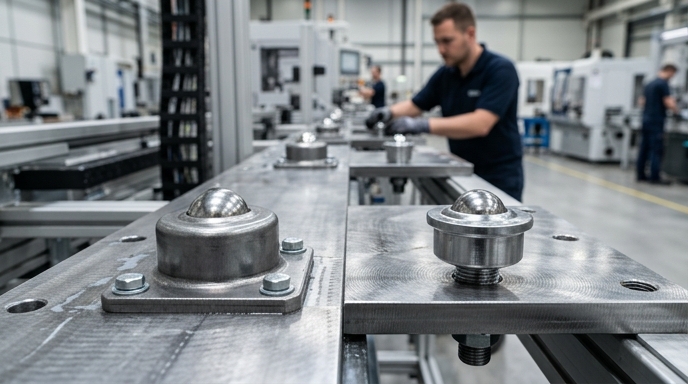
Flange-mount ball transfer units bolt to a surface through a flanged housing and suit high-load, high-vibration applications. Stud-mount units thread into a tapped hole or secure with a nut from below, giving you a lower profile and faster installation on thinner panels. Choose based on load, panel thickness, and serviceability.
The 30-Second Decision Rule
Flange mount for thin sheet metal panels or when you need top-down maintenance access. Stud mount for thick mounting plates, low-profile installations, or washdown environments where you can’t tolerate bacterial traps.
| Decision Criterion | Choose Flange Mount | Choose Stud Mount |
|---|---|---|
| Panel Thickness | < 8mm (0.315″) sheet metal | > 8mm (for tapped holes) |
| Maintenance Access | Top-down only (enclosed tables) | Bottom access available |
| Lateral Impact Loads | High (distributes shear force) | Low to Moderate |
| Sanitary Requirements | Poor (creates capillary gaps) | Excellent (fewer crevices) |
How Each Mount Transfers Load Into the Structure
Flange-mount BTUs distribute load across multiple fasteners in a bolt circle. Stud-mount units transfer load through a single axial fastener. That difference drives almost everything else.
When a heavy object rolls over a flange-mount unit, the vertical load transfers directly through the flange base into the mounting plate. The fasteners (typically two to four bolts) mostly see tension and hold the unit flat. If the load applies lateral force, say from a misaligned pallet skidding across the table, the shear force spreads across all the mounting bolts.
Stud-mount units concentrate the vertical load through the housing base resting on the panel, with the threaded stud acting as the primary anchor. Under lateral loads the single stud acts as a lever. If the housing base doesn’t sit perfectly flush against the mounting plate, lateral impact forces concentrate entirely on the stud’s root, and now you’re looking at bending or shear failure.
Load Capacity Reality Check — Static, Dynamic, and Impact
Catalog ratings almost exclusively state static load capacities, and mount style doesn’t inherently limit static capacity. The Hudson Bearings SBT-1 (1-inch ball, flange mount) and the SBT-1-Stud both carry a 75 lb static load rating. In heavy-duty lines, the Omnitrack 9050 (flange) and 9050-1 (stud) both support 1000 kg (2200 lbs).
But a conveyor doesn’t live in a static world. A 500 lb steel die dropping half an inch onto a ball table generates an impact force well above its static weight, and that’s the number that actually breaks things.
Alwayse Engineering recommends dividing the catalog static load by 3 to determine the safe dynamic load for applications involving shock or impact. I’d argue that’s the single most ignored line in any BTU catalog.
| Model (1″ Carbon Steel) | Mount Type | Catalog Static Load | Recommended Dynamic Load (Shock) |
|---|---|---|---|
| Hudson SBT-1 | Flange | 75 lbs | 25 lbs |
| Hudson SBT-1-Stud | Stud (5/16″-18) | 75 lbs | 25 lbs |
| Omnitrack 9050 | Flange | 1000 kg | 333 kg |
Panel Thickness, Hole Patterns, and the Hidden Geometry Constraint
Stud-mount BTUs typically need a panel at least 1x the stud diameter for steel, and 1.5x to 2x for aluminum, to get adequate thread engagement in tapped holes.
So if you spec a stud mount with a 5/16″-18 thread, you need a minimum steel plate thickness of 0.312″ (around 8mm). Tapping a 12-gauge (0.104″) sheet metal panel for a 5/16″ stud gives you less than two full threads of engagement. That’s not a mount, that’s a countdown timer. To use stud mounts on thin panels, you have to drill a clearance hole and secure the stud from below with a washer and a nylon-insert locknut. Which brings its own problems, as we’ll get to.
Flange mounts sidestep the whole issue. Load spreads across the flange, through-bolts do the holding, and you can mount them to 12- or 14-gauge sheet metal as long as the panel itself doesn’t deflect under the total payload.
Installation Labor and Total Installed Cost
Unit prices are basically a wash. A standard 1-inch carbon steel flange-mount unit retails around $11.50, the equivalent stud-mount around $12.25. Not where the money goes.
The cost divergence is in installation labor, and it cuts both ways depending on your panel.
Installing a flange mount means drilling a large center clearance hole for the barrel, plus drilling and tapping two to four smaller holes for the bolt circle. Installing a stud mount into a tappable panel means drilling and tapping a single hole. At 200 units for a custom ball table, the stud mount saves you something like 400 to 800 drilling and tapping operations. That adds up fast on a shop floor billing $95/hr.
If the panel is too thin to tap, though, the stud mount flips on you. Now you need a through-hole and a nut fastened from below, which is two-handed work (one wrench above, one below) and slower per unit than driving self-tappers into a flange from the top.
Serviceability and Replacement in the Field
When a BTU seizes from debris ingress or ball deformation, you need to swap it fast. This is the section where I’d argue most spec sheets fail the maintenance team, so bear with me.
Flange mounts win serviceability, hands down. Pull the two top-facing bolts, lift the unit out, drop a replacement in. One technician, top-side only, maybe three minutes if the bolts aren’t frozen. If you’ve ever had to change a BTU during a production stop on a high-SKU packaging line, you know those minutes are the whole ballgame.
Stud mounts secured with a nut need under-table access, and under-table access is where projects go to die. Reports from folks on industrial maintenance forums put the extra time at 10 to 15 minutes per unit on enclosed conveyor tables, and that matches what I’ve seen on food plant retrofits. If the conveyor design includes sub-plating or enclosed structural tubing, forget it — you may be dismantling a section of the line to reach one nut. I’ve watched a two-hour planned PM turn into a six-hour shift because nobody drew the maintenance envelope at the design stage. The lesson I keep re-learning: if you can’t picture the millwright’s hands on the fastener, don’t spec the fastener.
And then there’s the issue of the original installer using red Loctite on something that was supposed to come apart. But that’s a different article.
Failure Modes Specific to Each Mount Style
Each mounting style has its own ways of letting you down.
Flange Mount Failures:
- Flange deformation: If the center clearance hole in the panel is cut too large, the flange loses support near the barrel. Heavy loads dish or crack it.
- Fastener back-out: High-frequency vibration from hard resin pallets rolling over the balls backs standard mounting bolts out unless you’ve used thread-locker.
Stud Mount Failures:
- Thread stripping when tapped into soft aluminum without helical inserts, or when the installer gorillas the torque spec.
- Stud bending: lateral impact (forklift bumps a pallet on the table) applies shear force, and an undersized stud (1/4″-20 on a heavy-duty line, which you shouldn’t be running anyway) bends and permanently tilts the ball transfer.
Material and Environmental Spec Interactions
Food processing and pharma are strict about sanitary design, and in these environments stainless (304 or 316) stud mounts dominate the specs. The reason is geometry, not material.
Flange mounts create a flat-on-flat mating surface between the flange and the mounting plate, and that creates a capillary gap that traps moisture, cleaning chemicals, and bacteria. Stud mounts, especially with standoff washers or hygienic seals, minimize surface contact and eliminate blind crevices, which is what makes CIP and washdown procedures actually work.
A lot of manufacturers also offer stud-mount units with engineered dirt exit holes at the base of the stud, so debris and washdown fluid drain straight through the bottom of the unit instead of pooling in there.
Hybrid and Specialty Mount Options
When neither standard flange nor solid stud fits, specialty variations bridge the gap.
Spring-loaded ball transfer units (available in both flange and stud configurations, such as the Omnitrack 9000 series) use internal Belleville washers or coil springs. The ball retracts into the housing when the load exceeds a threshold, absorbing shock and spreading weight across multiple units when payloads are uneven. Useful on anything with unpredictable loading.
Drop-in or press-fit units skip fasteners entirely. A smooth or lightly knurled cylindrical housing presses directly into a precision-bored hole. They need tight machining tolerances (often +0.2mm) but installation and replacement are as fast as it gets.
FAQs
1. Can I replace a stud mount ball transfer with a flange mount of the same ball size?
Yes, but you’ll need to drill a larger center clearance hole for the flange barrel and drill/tap new holes for the bolt circle. Make sure the mounting plate is wide enough for the flange diameter.
2. What’s the typical load capacity difference between flange and stud mount BTUs?
Generally none. A 1-inch carbon steel unit in either style typically supports 75 lbs static.
3. Do I need thread-locker on stud mount ball transfers?
Yes. Vibration from moving loads will back studs out of tapped holes and loosen bottom-fastened nuts over time. Apply a medium-strength (blue) thread-locker during installation. Red is for things you don’t want to come apart on purpose, which is almost never a BTU. If you’re in a washdown environment, confirm the thread-locker is rated for your cleaning chemistry — some blue formulations soften with repeated caustic exposure, and then you’re back where you started.
4. Which mount type is better for food-grade applications?
Stud mounts.
5. What’s the minimum panel thickness for a stud mount BTU?
If tapping the hole, the steel panel needs to be at least 1x the diameter of the stud (so 0.312″ for a 5/16″ stud). If you’re using a through-hole and a nut, panel thickness is only limited by stud length.
Leave A Comment