
TL;DR: Ball transfer units (BTUs) sort into three buckets: mounting style (flange, stud, press-fit, drop-in), load capacity (micro, standard, heavy-duty), and material (carbon steel, stainless, plastic, hygienic). The thing that actually determines whether your table lasts five years or five months is dynamic load derating, which almost nobody calculates properly.
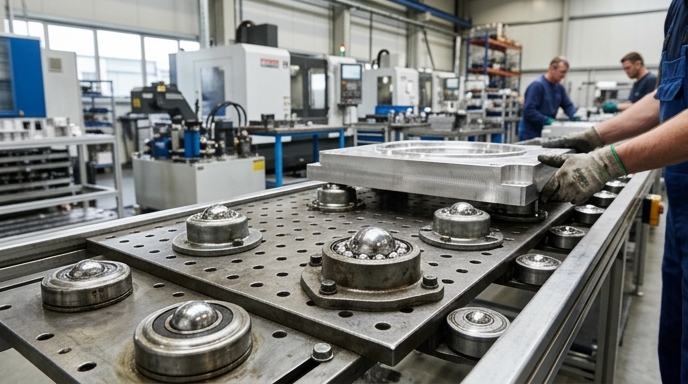
The Three Axes Every BTU Selection Hinges On
Specifying a ball transfer unit means solving three mechanical constraints at the same time. Every BTU choice is a mounting decision, a load decision, and an environment decision. Treat these as independent and you end up with a high-capacity carbon steel unit sitting in a washdown line, seized within weeks.
The first axis is the physical mounting constraint. Blind holes want stud mounts; flat plates want flange mounts. The second axis is load profile, which drives ball diameter and the internal track layout. The third is the material pairing between the BTU and the workpiece. A 2,000 kg capacity rating is meaningless if a hardened steel ball is chewing furrows into soft aluminum.
Mounting Style Breakdown — Flange, Stud, Press-Fit, Drop-In
Four standard mounting styles. Each solves a specific install or maintenance problem.
Flange Mount: Flat collar, two to four pre-drilled holes for bolts or rivets. Standard for warehouse conveyors and assembly tables because they go into flat sheet metal easily and swap out top-down without pulling the table apart. Hudson Bearings’ 1-inch flange units (FBT-1 and similar) need minimal clearance below the mounting surface.
Stud Mount: Threaded stem, typically M6 to M12 or 1/4″ to 1/2″. Used when you’re going into blind tapped holes or through thick structural channels. The nice thing is you can thread them up or down for height adjustment and lock with a jam nut.
Press-Fit (Tolerance Ring): Pushed directly into precision-bored holes, held by friction or a compressible tolerance ring. Common in European DIN-standard machinery and aerospace tooling where space is tight.
Drop-In: Sit loose in a bored hole, held by gravity and the weight of the load. Horizontal tables only — obviously you wouldn’t spec these on anything that tilts. The upside is maintenance can swap a jammed unit in seconds with no tools.
Load Capacity Classes — Micro, Standard, and Heavy-Duty
Capacity falls into three practical bands: micro (under 20 kg), standard (20–250 kg), and heavy-duty (250 kg to around 8,000 kg). It scales with the main ball diameter and the internal support ball configuration.
Micro Units: Main balls as small as 4.8 mm, handling 5 to 20 kg per unit. Electronics assembly, metrology benches, that kind of thing.
Standard Units: The workhorses. 15 mm to 25.4 mm balls, 20 to 250 kg each depending on housing thickness. Most logistics and general manufacturing lines run on these.
Heavy-Duty Units: Die handling, steel processing, aerospace tooling. These use machined steel housings instead of pressed sheet metal, and that’s the real difference. Omnitrack’s 9000 series handles up to 8,000 kg per unit on a 76.2 mm (3-inch) main ball. The solid machined cup is what keeps the housing from splitting under a true point load — a pressed housing will deform and spit the ball out long before the ball itself fails.
Why “Load Capacity” Lies — Static vs. Dynamic Derating
This is the section I’d put on a poster in every procurement office if I could.
Catalog load ratings are static capacity. That’s the maximum weight the BTU holds while sitting still without permanent deformation. The ball isn’t rolling, nothing’s dropping on it, nothing’s flexing. Spec a system off those numbers for a moving load and you will replace units constantly, and nobody on the floor will know why.
When a load drops onto a ball table, impact force multiplies the effective weight. Omnitrack’s engineering guidance recommends multiplying load by a shock factor of 1.5 for light impacts, up to 2.0 or even 3.0 for heavy drops. If you’re setting a 1,000 kg steel die on a table with a crane, the system needs to be rated for 2,000 kg dynamic, minimum. I’ve seen plants running at 1.2x “because the operator is careful” and then wondering why they’re replacing six units a quarter on one station. The operator is not careful. Nobody is careful at 3 AM on a Sunday shift.
The other thing standard load math gets wrong is the three-ball assumption. Catalog calculations assume load distributes evenly across three balls. Fine for a flat, rigid plate. But if the workpiece has an uneven bottom, or any flex at all, the whole load can momentarily land on one BTU. That single unit’s dynamic capacity has to clear the total workpiece weight on its own. Not a third of it. All of it.
I still spec stainless on indoor dry-environment jobs more often than the numbers justify. Old habit from a food plant I did a lot of work in early on, and I know it’s overkill. I do it anyway.
Housing & Ball Materials — Matching the Environment
Material selection drives both BTU lifespan and the condition of the part moving across it.
Carbon Steel (Standard): Default for dry indoor industrial. Zinc-plated or oiled carbon steel housing and balls. Highest capacity, lowest cost, zero moisture tolerance.
Stainless Steel (304/316): Corrosive environments and outdoor work. Expect to lose 10% to 20% of max capacity going from carbon steel to stainless, because 300-series is softer than hardened carbon.
Nylon/Acetal Balls: Mandatory for glass, polished aluminum, or painted sheet metal — anywhere a steel ball would gouge the workpiece. Swap steel for nylon in the same housing and you lose roughly half the load capacity.
ESD-Safe: Standard plastic balls build up static, which is a problem in electronics. ESD-safe versions use carbon-impregnated nylon to ground the workpiece through the housing into the table frame.
Specialty Variants — Spring-Loaded, Inverted, and Sealed
Standard BTUs give up fast when you throw extreme shock, overhead mounting, or heavy debris at them. Specialty variants change the internal mechanics to deal with each.
Spring-Loaded: Ball assembly rides inside a secondary cylinder backed by a coil or Belleville spring, with up to 12 mm of vertical travel. Two jobs: absorbing drop-shock, and equalizing load across multiple units when a rigid workpiece moves over an uneven floor. The second one matters more than people think — a warehouse floor is never as flat as the drawing says.
Inverted (Ball-Down): Standard units don’t work upside down. The internal support balls fall away from the main ball and the thing either locks up or drags. For overhead rails and hold-down clamps you need “endless track” or specific heavy-duty designs (Alwayse Hevi-Load, Omnitrack 9000) that mechanically retain the support balls against the main ball no matter which way the housing is pointed.
Sealed/Wiper Units: Foundry and woodworking dust gets into open housings and grinds the support balls into powder. Sealed units have a felt or plastic wiper around the main ball that scrapes debris before it enters the track.
Hygienic and Food-Grade BTUs — A Category of Their Own
Food and pharma need washdown-rated hardware, and a standard stainless BTU will fail a hygiene audit the first time somebody looks inside the housing. Internal cavities trap water, bacteria, and whatever caustic cleaner the plant is running that week.
True hygienic BTUs are 316L stainless with large debris exit holes machined into the base so high-pressure CIP water can flush the internal support ball track. Official EHEDG certification is notoriously hard to get for ball transfers because of the unavoidable metal-on-metal contact points inside. Most of what gets sold as “hygienic” is really washdown-rated, which is not the same thing, and the distinction matters if you’re doing a formal audit.
Food-grade units often run unlubricated or on FDA-approved food-safe grease. Aggressive washdowns strip lubrication fast, so these units wear out faster than general industrial BTUs. Build the replacement schedule into the maintenance plan from day one.
Ball Spacing Math for Ball Transfer Tables
A workpiece has to contact at least three ball transfer units at all times. Fewer than three and it tips, catches an edge, or jams.
You can calculate a theoretical minimum on a square grid as center-to-center ≤ smallest workpiece dimension ÷ √2, but manufacturers use a safer rule to account for load rotation and uneven edges: divide the narrowest dimension of the load by 3.5.
Worked Example:
Moving steel plates that measure 400 mm by 600 mm. Narrowest dimension is 400 mm.
400 mm ÷ 3.5 = 114.2 mm.
Maximum center-to-center spacing is 114 mm. Space them any further and the 400 mm edge drops between the balls and the plate digs into the table.
Failure Modes and Service Life by Type
Knowing how each type fails tells your maintenance crew what spares to keep and how often to inspect.
Contamination Jamming: Most common failure on open-housing BTUs. Dust and metal shavings get in and bind the support balls. Spec units with dirt exit holes or felt wipers.
Corrosion Pitting: Carbon steel in humid air or near coolant. The support balls rust and the whole thing turns from smooth omnidirectional roll to grinding drag. Go up to 304 stainless.
Plastic Deformation: Nylon balls develop flat spots when heavy loads sit on them static over a weekend. I’ve seen this plenty on engineering forums and plenty on real shop floors. Fix is either spring-loaded units to distribute the load, or go back to steel balls if the workpiece can take it.
Standard pressed-steel units in continuous conveyor applications want relubrication with light machine oil every 6 to 12 months. Sealed heavy-duty units can go years before bearing wear forces a replacement, depending on duty cycle.
FAQ
What’s the difference between flange-mount and stud-mount ball transfer units?
Flange-mount units have a flat collar with bolt holes, meant to drop into a cutout on flat sheet metal. Stud-mount units have a threaded stem that threads into a tapped hole or passes through a structural frame and gets locked with a nut.
Can ball transfer units be mounted upside down or sideways?
Not the standard ones. The internal support balls fall away from the main ball and the unit jams or drags. For inverted or sideways work you need “endless track” or solid-cup designs rated specifically for ball-down orientation. Alwayse Hevi-Load and the Omnitrack 9000 are the two most people reach for, but check the orientation rating on the datasheet before you commit — some units rated for 90-degree mounting are not rated for full inversion, and the catalog language on this is often sloppy.
How do I calculate the number of ball transfers needed for a table?
Take the shortest dimension of the smallest part you’ll convey, divide by 3.5. That’s the maximum center-to-center pitch between units.
Are plastic ball transfer units as durable as steel ones?
No. Roughly half the load capacity of equivalent steel, and they flat-spot under static loads over long periods. Use them only when you have to protect the workpiece surface.
Dave Kurtz spent 18 years specifying conveyor and transfer hardware for materials handling integrators before going independent. He writes about mechanical component selection for people who have to make the catalog spec match what actually happens on the floor.
Leave A Comment